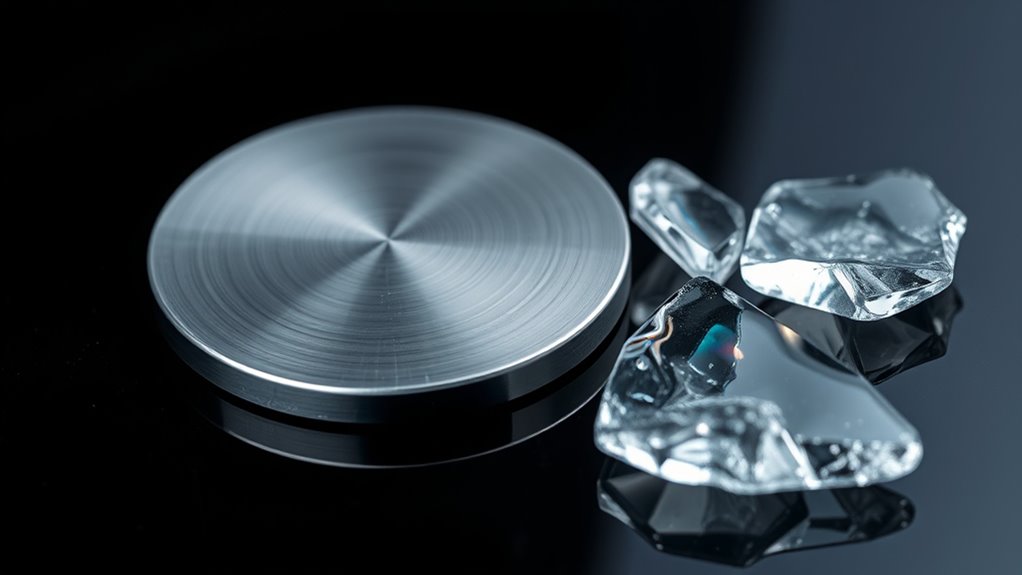

Biocompatible materials like titanium, niobium, and glass play an essential role in medical implants by ensuring they smoothly integrate with your tissues while minimizing immune reactions. Titanium is widely used for its strength, corrosion resistance, and ability to fuse with bone. Niobium offers excellent corrosion resistance and suits sensitive patients, while bioactive glass promotes tissue growth and healing. To discover how these materials are shaping healthcare advances, explore further details below.
Key Takeaways
- Titanium is the gold standard for implants due to its excellent biocompatibility and ability to fuse with bone (osseointegration).
- Niobium offers superior corrosion resistance and a lower modulus of elasticity, making it suitable for sensitive or long-term implants.
- Bioactive glass promotes tissue regeneration and bonding, supporting bone repair and soft tissue integration.
- All three materials—titanium, niobium, and glass—are designed to minimize immune responses and enhance healing.
- Advances in material science continuously improve the performance, safety, and longevity of biocompatible implants.
Have you ever wondered how medical implants and devices seamlessly integrate with your body? It’s fascinating to realize that behind the scenes, advanced materials make this possible. When it comes to biocompatible materials, titanium, niobium, and glass stand out for their unique properties and compatibility with human tissue. These materials are critical in numerous medical applications, from dental implants to bone replacements, because they minimize immune responses and promote healing.
Focusing on dental implant innovations, titanium has become the gold standard. Its success largely hinges on its metallic alloy properties, which combine strength, durability, and excellent biocompatibility. Titanium’s ability to fuse with bone through osseointegration ensures that implants stay firmly in place, providing a stable foundation for dental restorations. Its corrosion resistance is another key factor, preventing deterioration inside the mouth’s moist environment. These properties allow dental implants to last for decades with minimal complications, revolutionizing restorative dentistry. The development of titanium alloys, such as Ti-6Al-4V, has further enhanced implant performance by optimizing strength-to-weight ratios and reducing potential allergic reactions.
The metallic alloy properties of these materials are central to their success. They are engineered to withstand the mechanical stresses of daily use while maintaining compatibility with biological tissues. For instance, niobium shares many attributes with titanium but offers even better corrosion resistance and a lower modulus of elasticity, making it suitable for specific implant applications. Its inert nature minimizes immune responses, making it an excellent choice for patients with sensitivities. Meanwhile, glass, particularly bioactive glass, offers a different advantage. It encourages tissue regeneration and bonding at the interface, which is especially useful in bone repair and eye surgeries. Its ability to bond directly with bone and soft tissue makes it a versatile material in the sphere of biocompatible implants. Additionally, these materials are often selected for their metallic alloy properties, which are crucial for their performance in biological environments.
In essence, these materials are designed with a deep understanding of their metallic alloy properties and biological interactions. They are tailored to foster integration rather than rejection, ensuring that your body accepts and adapts to the implant. Advances in material science continuously push the boundaries, improving implant longevity and performance. As a result, you benefit from safer, more effective treatments that restore function and improve quality of life. The seamless integration of these biocompatible materials exemplifies how science and innovation come together to enhance healthcare and patient outcomes.
Frequently Asked Questions
How Do Biocompatible Materials Affect Long-Term Implant Stability?
Biocompatible materials substantially enhance long-term implant stability by promoting better integration with your body tissue. They reduce the risk of rejection and inflammation, which can compromise implant longevity. When you choose materials like titanium or niobium, you’re more likely to experience durable, stable implants that last longer. This improved compatibility ensures that your implant remains secure and functional over time, supporting your overall health and reducing the need for future procedures.
Are There Any Allergies Associated With Titanium, Niobium, or Glass?
You might wonder if allergies lurk with titanium, niobium, or glass. The truth is, allergy prevalence is low, but immune responses can happen unpredictably. Titanium and niobium rarely cause reactions, making them safe choices for most. Glass, though generally inert, can sometimes trigger sensitivities in rare cases. Keep in mind, individual immune responses vary, so monitoring is vital to make sure that your implant remains compatible and safe over time.
How Do Surface Treatments Improve Biocompatibility?
Surface treatments like surface modification and coating techniques considerably enhance biocompatibility by creating a more favorable interface between your implant and tissue. These methods reduce immune response, promote better cell adhesion, and prevent corrosion or bacterial buildup. By applying coatings such as hydroxyapatite or titanium oxide, you improve the implant’s integration with your body, ensuring it works harmoniously and lasts longer without adverse reactions.
Can These Materials Be Used in Pediatric Implants?
While these materials are generally suitable for pediatric implants, you should consider pediatric growth and material durability. Titanium and niobium’s flexibility supports growth, but their strength ensures longevity. Glass, though biocompatible, may lack the necessary durability for active children. You need to weigh these factors, guaranteeing the implant adapts safely as a child grows while maintaining structural integrity over time.
What Are the Environmental Impacts of Manufacturing These Materials?
You should know that manufacturing titanium, niobium, and glass impacts the environment through resource extraction, which can harm ecosystems and deplete natural reserves. The environmental footprint involves energy use, greenhouse gas emissions, and waste generated during processing. While these materials are valuable for medical applications, their production processes can have significant ecological effects. Reducing energy consumption and adopting sustainable practices are essential to lessen their environmental impact.
Conclusion
So, there you have it—titanium, niobium, and glass, the dream team of biocompatible materials. They’re basically the superheroes of the medical world, fighting off rejection and making your body feel right at home. Who knew that metals and glass could be so charming? Next time you marvel at implants or prosthetics, remember, it’s these materials that make your body’s new best friends possible. Cheers to science’s shiny, uncomplaining heroes!